Have you ever wondered why golf balls have dimples on their surface, unlike any other ball?
The 300-500 dimples on each ball, each about 0.010 inches deep, are certainly not for aesthetic purposes. They are there for a purpose.
It is a story of aerodynamics, air pressure and turbulence. Some golf balls have hexagonal dimples that can also be designed to enhance aerodynamic performance.
If the ball is smooth, it will only travel half the distance compared to a ball with dimples when hit by a professional golfer.
When a golfer hits the ball, the impact between the ball and the club lasts only 1/2000 of a second.
This impact, or what scientists in this industry call launch condition, determines the ball’s velocity, launch angle and spin rate.
After the 1/2000-second impact on the ball, gravity and aerodynamics determine the ball’s trajectory. This is where the dimples play their role.
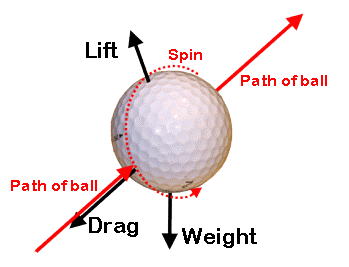
When the golf ball is hit, an initial thrust force pushes the ball forward and upward.
As it heads along its flight path toward the hole, the ball’s motion creates thin layers of air directly above and below that move along with the ball faster than the air beyond.
The faster the air moves, the less pressure it exerts. We can relate this effect to Bernoulli’s Principle.
This lower-pressure air around the ball helps generate lift, a force that pushes the ball upward.
The more lift a ball has, the further it can go. At the same time, air pressure and wind resistance push back against the ball, creating drag, a force that slows a moving object.
All these forces (thrust, drag, lift, gravity) affect how high and far a golf ball can move.
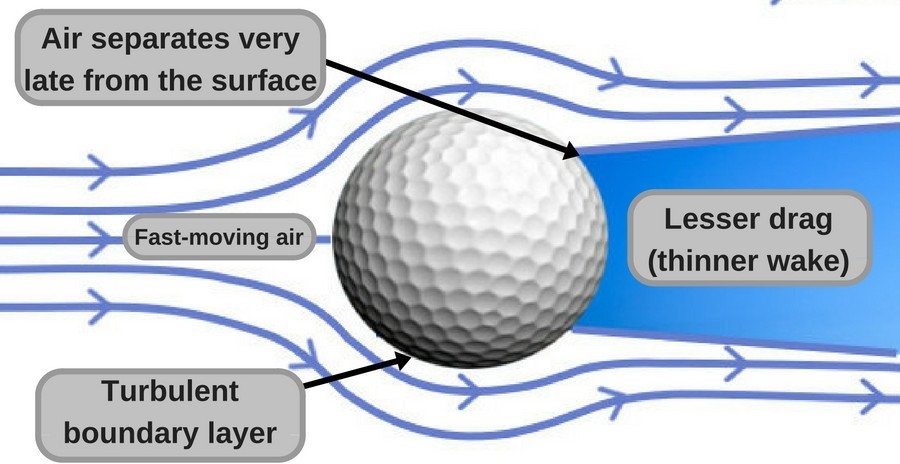
When air moves around any object, it exerts force. An object with an aerodynamic shape breaks this force into two components: lift and drag.
Drag, as its name suggests, opposes the motion, while lift acts in a direction perpendicular to the motion.
In the case of the golf ball, lift acts upward since the motion is forward.
Dimples may also increase spin. As a ball moves forward through the air, the dimples cause the ball to spin backwards, pulling the airflow downwards.
The air pressure on the bottom of the ball is higher than the air pressure on the top.
The imbalance of the pressure creates an upward force on the ball.
These are the same principles of aerodynamics that aeroplanes use to fly.
The spin itself contributes about one-half of a golf ball’s lift.
The other half is provided by the dimples, which optimise lift.
The dimples force airflow downward, pushing the ball upward according to Newton’s Third Law (every action has an equal and opposite reaction).
Let us imagine a smooth ball. The smooth ball will take off on a much lower trajectory.
Without the aerodynamic effect, there will be no ‘climbing’ effect.
They will also travel unpredictably through the air, and golfers will have little control over the flight of smooth balls.
How did science get into golf balls? Golf was first played in Scotland, and players at the time used wooden clubs and balls.
This later evolved into balls made from goose feathers, tightly pressed into a horse- or cowhide sphere while still wet, then allowed to dry.
After drying, the leather shrank and the feathers expanded, creating a hardened golf ball.
This was too expensive for everyone, and only the privileged played the game (which is not too different from now).
The next generation of balls was made from the Gutta tree in the tropics.
It was cheaper, and the rubber-like substance made reheating and reshaping easy.
The balls made from the feathers were said to travel farther than the Gutta balls because this ball’s smooth surface prevented it from covering more distance. This was the start of dimpled golf balls.
The evolution of golf balls began in the 15th century, and modern golf balls were introduced in 1905, though experts continue to improve them today.
In 1921, the golf ball took its current form with standard size and weight. Now, some golf balls offer control, and others offer better distance – all aided by science.
Prepared by:
Dr Mahaletchumy Arujanan