Pharmacy education has traditionally relied on lectures and direct instruction, which can be challenging for students because of the extensive content requiring significant memorisation.
This can lead to students struggling to understand the clinical relevance of the material and high stress levels when completing assignments.
Amidst the challenges that pharmacy education already faced, the advent of the COVID-19 pandemic further compounded the complexity for students.
Nevertheless, adopting technology-enhanced learning (TEL) through online platforms has emerged as a silver lining amid adversity, proving a beacon of hope for the continued progress of pharmacy education during these trying times.
Incorporating TEL has had a remarkable positive impact on pharmacy students’ education, alleviating stress and propelling academic growth.
A particularly effective approach to incorporating TEL into pharmacy education is using movies.
Research has shown that movies can significantly enhance memory retention, promote critical thinking, inspire scientific curiosity, and unlock latent creativity, while activating prior knowledge to elevate student performance.
Science fiction movies are a great option to provide an engaging and practical learning experience for students taking microbiology, virology, and biochemistry courses.
These movies can effectively increase students’ conceptual knowledge by presenting questions and incorporating a problem-solving theme.
What’s more, Hollywood production houses frequently consult academic researchers as scientific advisors, ensuring that the movies provide a reliable and authentic virtual learning environment that is safe and engaging for students.
An innovative movie review assignment was introduced to second-year undergraduate pharmacy students of Universiti Malaya to enhance the traditional approach to teaching pharmacotherapy for infectious diseases.
The study aimed to gauge the students’ perceptions of the movie-based learning experience.
This engaging assignment involved watching pandemic-themed movies Contagion (2011) and Outbreak (1995) and critically analysing their scientific accuracy.
They were asked to evaluate these scenes’ accuracy and depiction of key concepts related to infectious diseases, such as disease management and containment, viruses, pathogenicity, and vaccination.
The students were also encouraged to identify any instances of “science gone wrong” or inaccuracies in the movies and to share their perspectives on how the movies’ content relates to the current COVID-19 pandemic.
The study results showed that most students had a positive perception of the movie review assignment.
Many participants found the assignment enjoyable, fun, and interesting, as it challenged their knowledge and understanding of infectious diseases.
The students perceived that they had improved their knowledge of the course content.
This new approach was a valuable experience that emphasised the development of key communication and critical-thinking skills.
This was demonstrated through the high assessment scores. The average score among the 12 video presentations was 74.5% (37.25 out of 50 marks), with a maximum of 84%, a minimum of 64%, and a median score of 72.24%.
Most students, totalling 45 (95.7%), would highly recommend the movie review assignment to future students.
This recommendation is based on their perception that the assignment was enjoyable and engaging and provided a welcome change from traditional writing assignments.
Furthermore, collaboration and interaction among students during the assignment were seen as a significant positive aspect, as they helped develop their soft skills, such as communication and teamwork.
However, a small minority of 2 students (4.3%) did not recommend the assignment because they believed it was time-consuming.
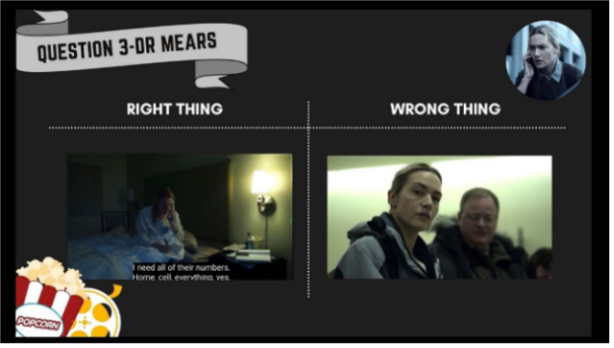
Screenshot of an example of the pre-recorded video presentation by the students.
The movie review assignment was both challenging and beneficial for the students.
Most students found the easiest part of the movie review assignment to be searching, watching, and understanding the movies.
This indicates that the students could engage effectively with the movie material and extract information from it.
On the other hand, the hardest part of the assignment for the students was the time limit for the video presentation.
The time constraint seemed to be the biggest challenge for the students.
To overcome this, the students reported having more discussions to select the most suitable and rational answers for the video presentation.
This shows that the students could work together effectively and find solutions to overcome their challenges.
The students’ suggestions provide valuable insights for improving future iterations of the movie review assignment.
It is worth noting that students’ suggestions indicate a need for a balance between the challenge and difficulty of the assignment and students’ abilities and workload.
Extending the time limit and reducing the workload could help students overcome some of the challenges they faced in completing the assignment.
Additionally, providing related movie options and making the movie links readily available could enhance students’ learning experience and engagement with the assignment.
Educators should consider these suggestions and make adjustments to ensure students have a positive, productive learning experience and improve their comprehension of the course material.
In conclusion, using movies as a teaching tool proved valuable in providing students with an interactive and engaging learning experience that fostered their critical thinking and collaboration skills.
While the movie review assignment undeniably delivers numerous benefits, it is important to acknowledge its challenges, particularly regarding time management.
Considering these findings, it is evident that future iterations of this assignment would greatly benefit from integrating structured preview sessions and implementing clear presentation guidelines.
Incorporating these enhancements can improve the assignment’s effectiveness and ensure a more rewarding educational experience for pharmacy students.