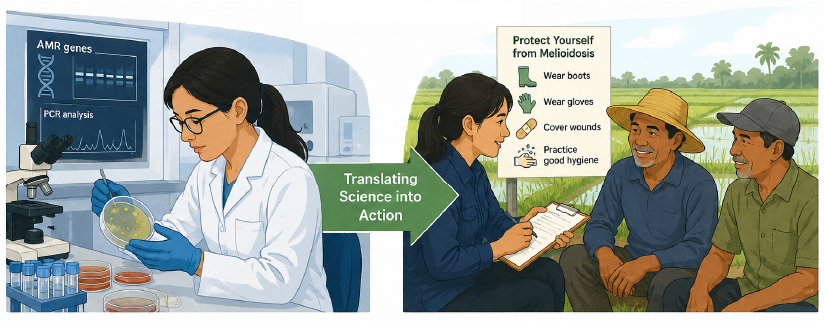
For most of my career, I lived among petri dishes, culture plates, and microbial colonies.
I was trained to think in terms of gene targets, resistance patterns, and lab protocols. My early years were grounded in bacteriology: isolating pathogens, identifying antimicrobial resistance genes, validating laboratory methods, and troubleshooting experiments that refused to cooperate.
The laboratory was structured, controlled, and, in its unpredictability, predictable. If something failed, I could usually trace it back to a reagent, contamination, temperature, or technique.
I used to sleep over in the lab for days, and as a homegrown graduate, I also travelled abroad to explore research opportunities. My love towards research was intense.
That world shaped my scientific discipline.
But science, especially in Malaysia, does not operate in isolation from reality.
As I worked more closely on melioidosis and antimicrobial resistance, a pattern became obvious. We had the organisms characterised. We had genomic insights. We had laboratory confirmation.
Yet cases persisted. Farmers remained exposed to the bacteria. Preventive measures were inconsistently practised. Awareness was uneven.
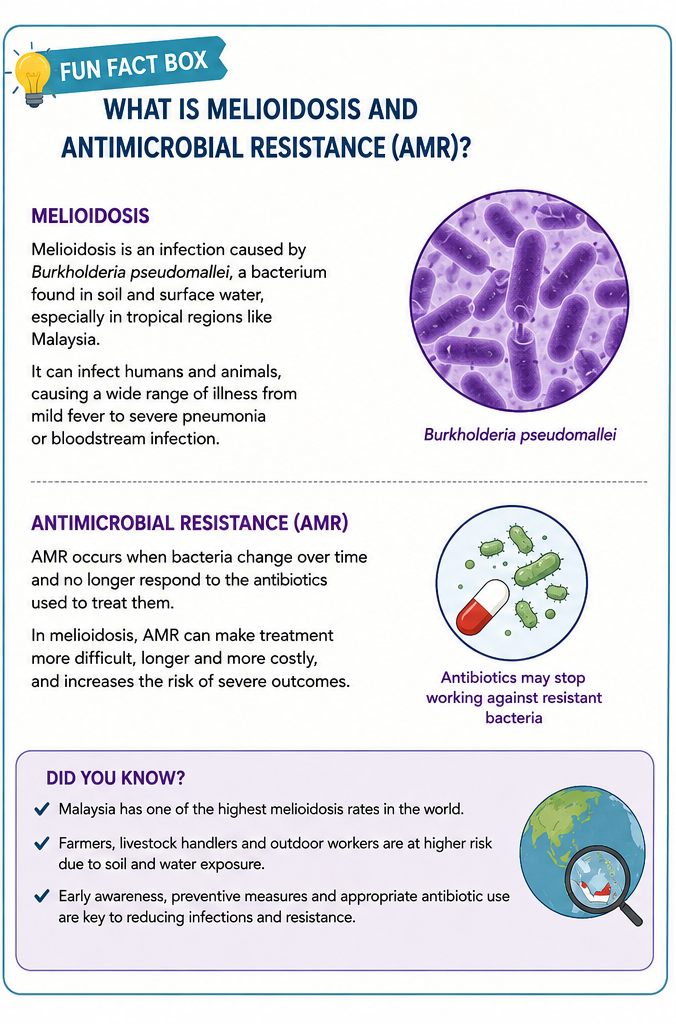
Illustration generated using AI.
The problem was no longer just microbiological. It was behavioural.
That realisation unsettled me. I had spent years strengthening my wet-lab expertise.
I was comfortable there. My identity was tied to being a laboratory scientist. But when grant panels and national priorities began emphasising community impact, translational research, and behavioural intervention, I had to confront a hard truth: generating laboratory data alone was not enough.
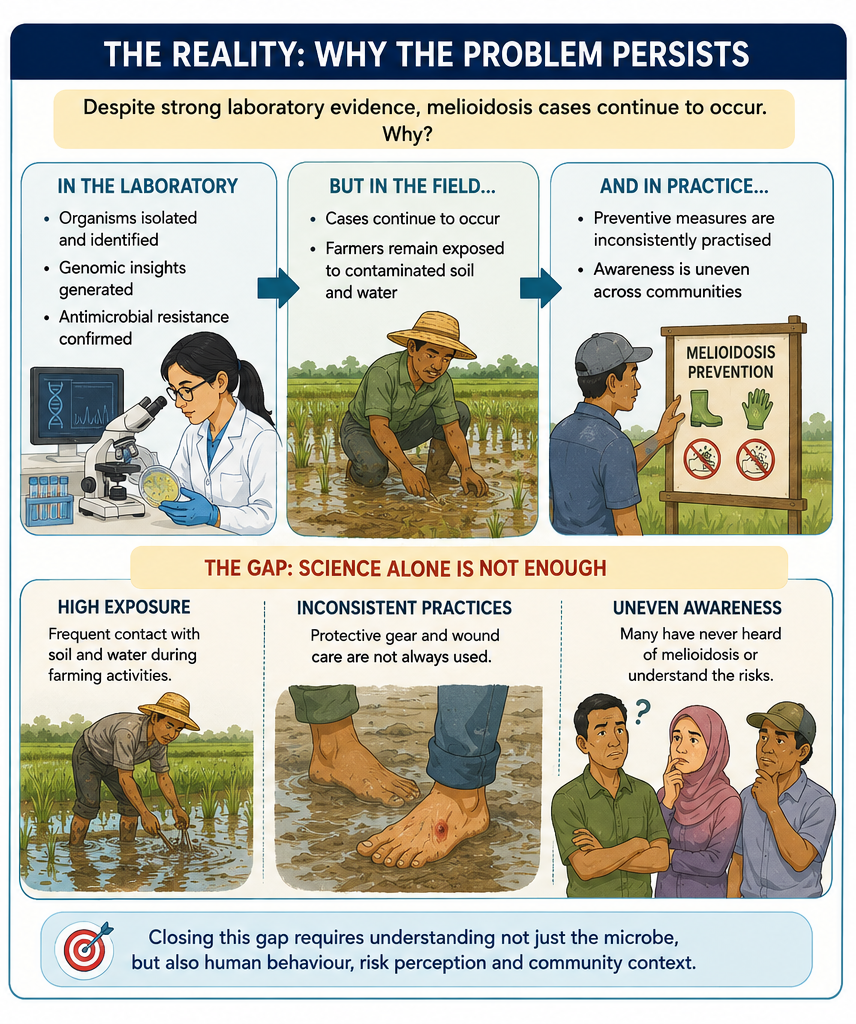
Illustration generated using AI.
Funding realities sharpened that truth.
Wet-lab research demands substantial funding for consumables, reagents, equipment maintenance, and biosafety compliance.
As grants grew more competitive, proposals focused purely on laboratory detection became harder to sustain unless they demonstrated a straightforward public health application.
Reviewers wanted impact pathways. They wanted behavioural outcomes. They wanted measurable change at the community level.
So, I pivoted.
The transition was not dramatic. It was gradual, strategic, and uncomfortable.
I began designing studies on knowledge, risk perception and preventive behaviour among farmers and park visitors.
Instead of culturing bacteria, I developed questionnaires and interviewed people about their understanding of disease risks.
Instead of analysing polymerase chain reaction (PCR) bands, I was interpreting survey responses and statistical trends.
Instead of asking, “Is the gene present?” I was asking, “Why are preventive measures not being practised?”
The first time I conducted field data collection in the Tanjung Karang paddy fields, I felt more vulnerable than I ever did handling pathogens in the laboratory.
In the lab, I controlled the environment. In the field, human responses were complex, layered, and sometimes contradictory.
There were no sterile conditions. Social norms, personal beliefs about risk, and economic pressures were factors that no incubator could regulate.
Yet the impact felt immediate.
When the farmers and the agricultural officers told me they had never heard of melioidosis, despite decades of working in soil, I understood the gap more clearly than any dataset could.
When respondents admitted they knew the risks but prioritised convenience over protective practices, I saw the behavioural dimension of disease transmission.
The scientist in me adapted.
I learned survey validation. I studied behavioural frameworks.
I collaborated across disciplines. Statistical software replaced some of my laboratory hours. Data visualisation has become as crucial as agar preparation once was. I started asking not only how bacteria cause disease but also why people do or do not take steps to protect themselves.
This was not a rejection of my laboratory roots. It was an expansion of responsibility.
Microbes do not act alone. Human behaviour shapes exposure, transmission, and prevention.
If I genuinely wanted to reduce disease burden, I had to step beyond the bench. The shift also brought strategic clarity. Social and behavioural studies are scalable. They require different resources, such as time, planning, and analytical rigour, but not the constant drain of consumables.
In a funding climate where sustainability matters, designing research that integrates laboratory evidence with behavioural insight is not just innovative; it is pragmatic.
Today, my work sits at the intersection of microbiology and society.
I still respect the lab.
It trained me to value precision and evidence. But my research questions are now broader. I am not only asking what pathogens do. I am asking why people respond or fail to respond to risk.
That transformation changed how I see science.
Impact is not measured only in publications or gene sequences.
It is measured in raised awareness, improved practices, and empowered communities. Moving from petri dishes to people was not abandoning wet-lab-based science. It was about choosing to make it matter differently, bridging the gap between microbial mechanisms and human behaviour to impact society.
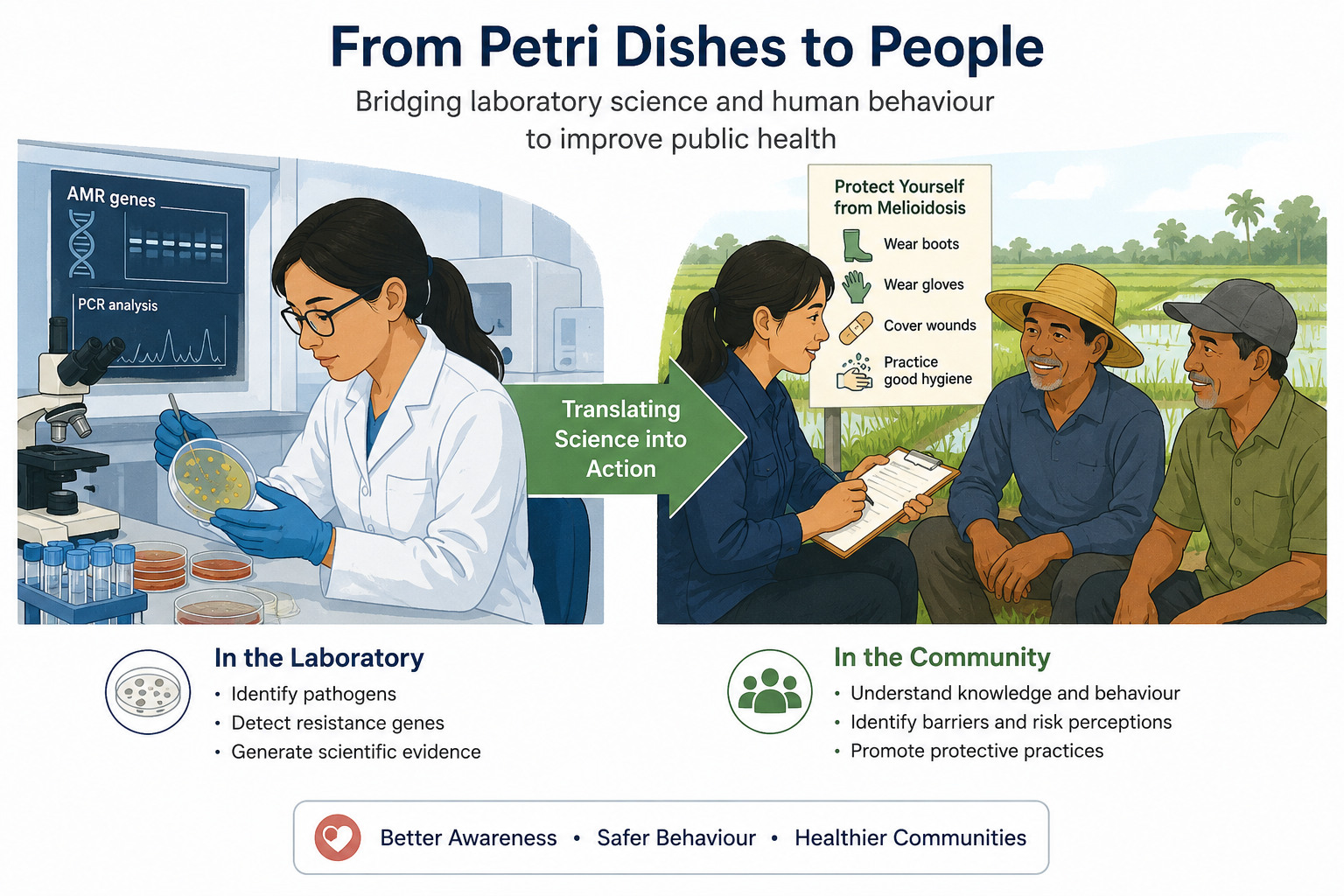
Illustration generated using AI.
In that shift, I didn’t stop being a scientist.
I became one who listens as much as she measures.
Prepared by: