Far below the bright skin of the sea, in an ink-black world where the cold nips like a freezer and pressure can crush a soda can in a blink, incredible microbes thrive in a place with no morning.
Just when you think nothing could live there, the seafloor cracks and the ocean begins to “breathe.” From the split rises a mineral chimney, puffing a dark, glittering cloud. This is a hydrothermal vent, an underwater hot spring where seawater shoots back out at over 350 °C.
When that super-hot water meets the icy deep, dissolved metals harden into tiny crystals, stacking up until a tower stands as tall as a two-story shop lot. Whole neighbourhoods of vents stretch longer than a football field, their swirling “smoke” actually millions of mineral specks.
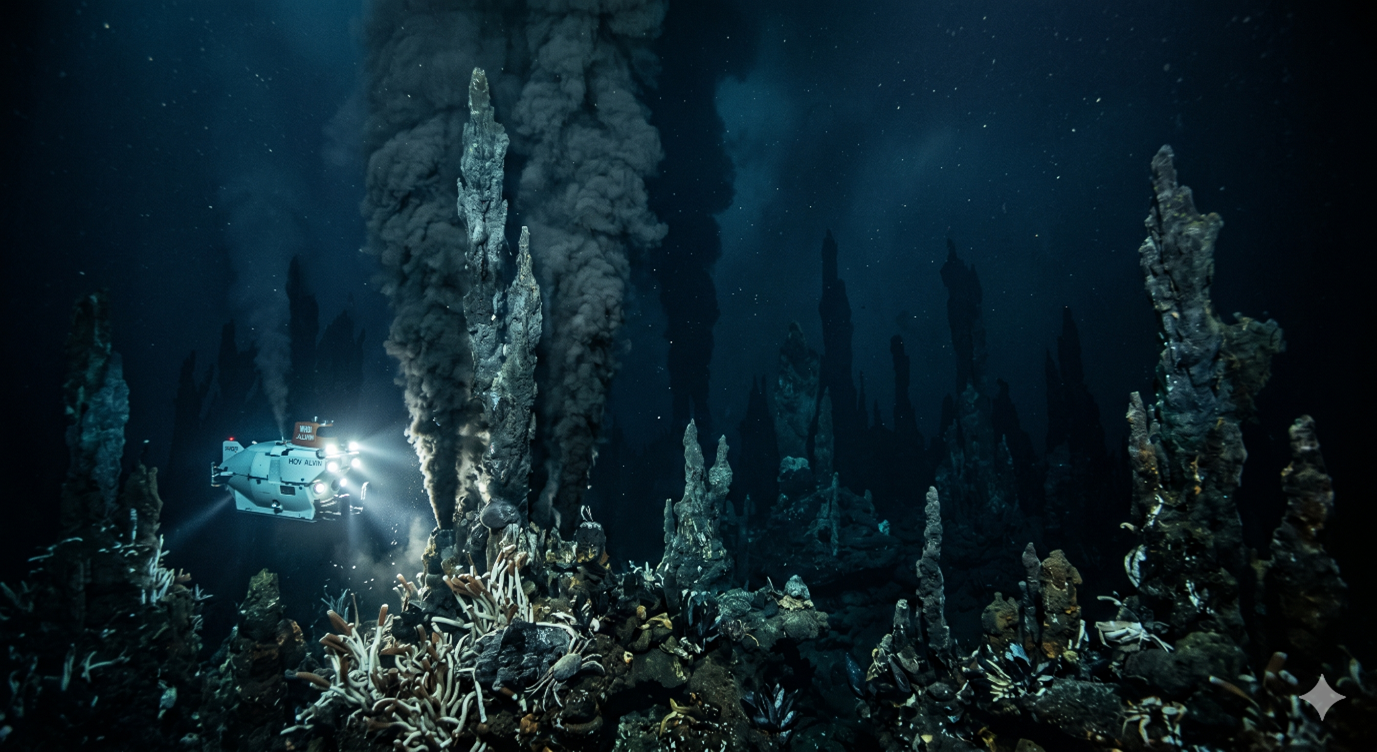
Overview of a hydrovent. (Image was generated using AI)
Sunlight never arrives here, so the city runs on chemistry. Tiny microbes (both bacteria and archaea) plug into the vent’s chemical battery. They sip hydrogen sulfide (the rotten-egg gas) and dissolved carbon dioxide, using the energy in those chemicals to build sugars. This superpower is called chemosynthesis. If photosynthesis is a solar panel, chemosynthesis is a power station the size of a cell.
Some of the best chemical engineers belong to a group called Campylobacterota: Sulfurovum and Sulfurimonas thrive in the vent’s sulfur-rich water, turning toxic sulfide into food. On the chimneys themselves, rust-colored “gardens” are built by iron-oxidising Mariprofundus ferrooxydans, weaving delicate iron filaments as it feeds.
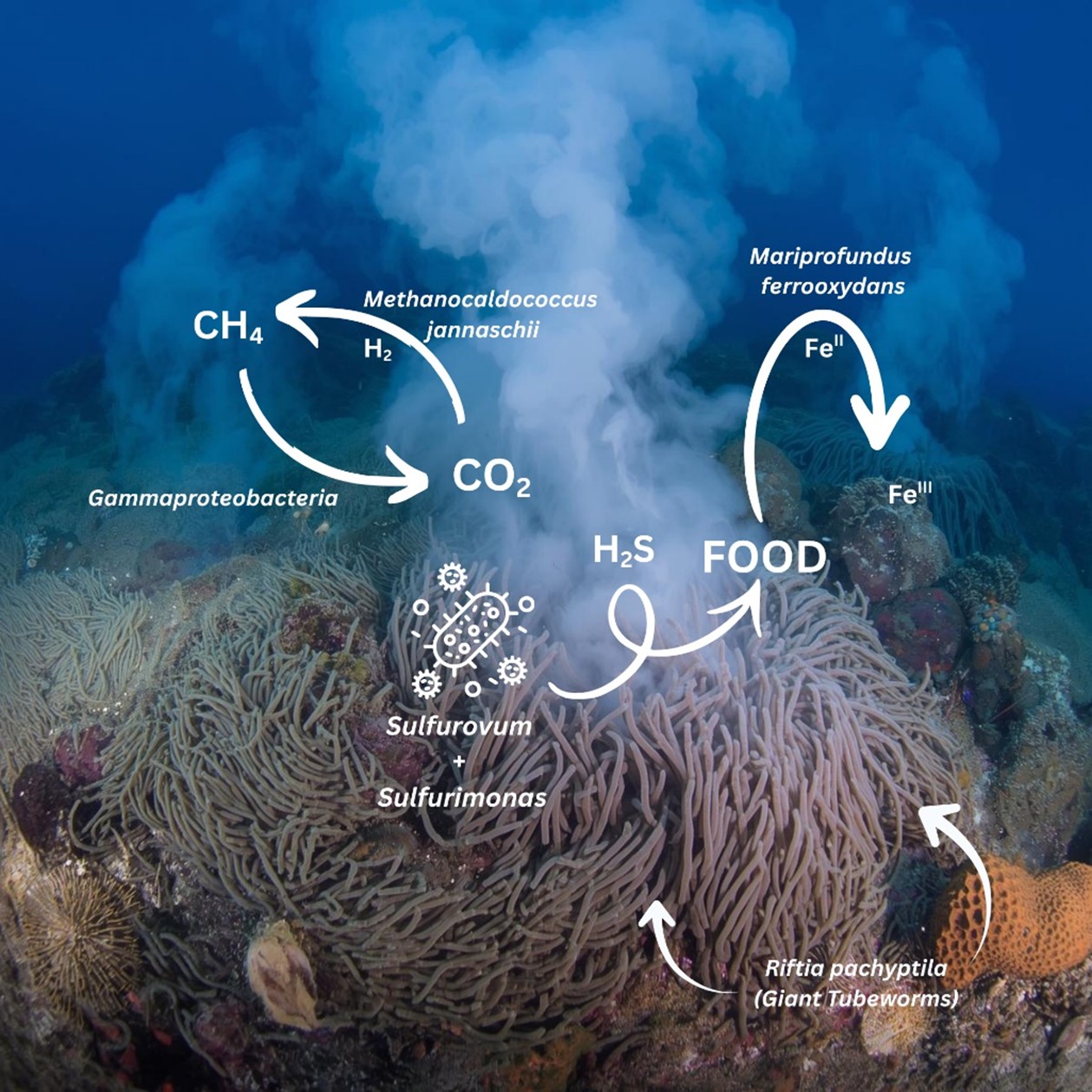
Chemosynthesis in action. (Created with Canva)
Life here doesn’t just survive heat; it loves it! In the hottest nooks, archaeal superheroes take the lead. Pyrolobus fumarii can grow at around 113 °C, while the speedy little coccoids Thermococcus and Pyrococcus have enzymes that keep working when ordinary proteins would wilt.
Another famous vent archaeon, Methanocaldococcus jannaschii, helped scientists decode the third branch of life; it makes methane by combining hydrogen with carbon dioxide. That methane does not go to waste. Methane-eating bacteria (Gammaproteobacteria) and special archaea (ANME) team up to scoop it up as food. It’s a tidy chemical market where nothing is thrown away.
Because microbes manufacture food from chemicals, larger animals can build neighbourhoods around the chimneys. The superstar is the giant tubeworm Riftia pachyptila. Lacking a mouth and stomach, it hosts a community of sulfur-oxidising bacteria (“Candidatus Endoriftia persephone”) within a specialised organ. The worms deliver hydrogen sulfide and oxygen through bright red plumes, and Endoriftia pays the rent by making sugar.
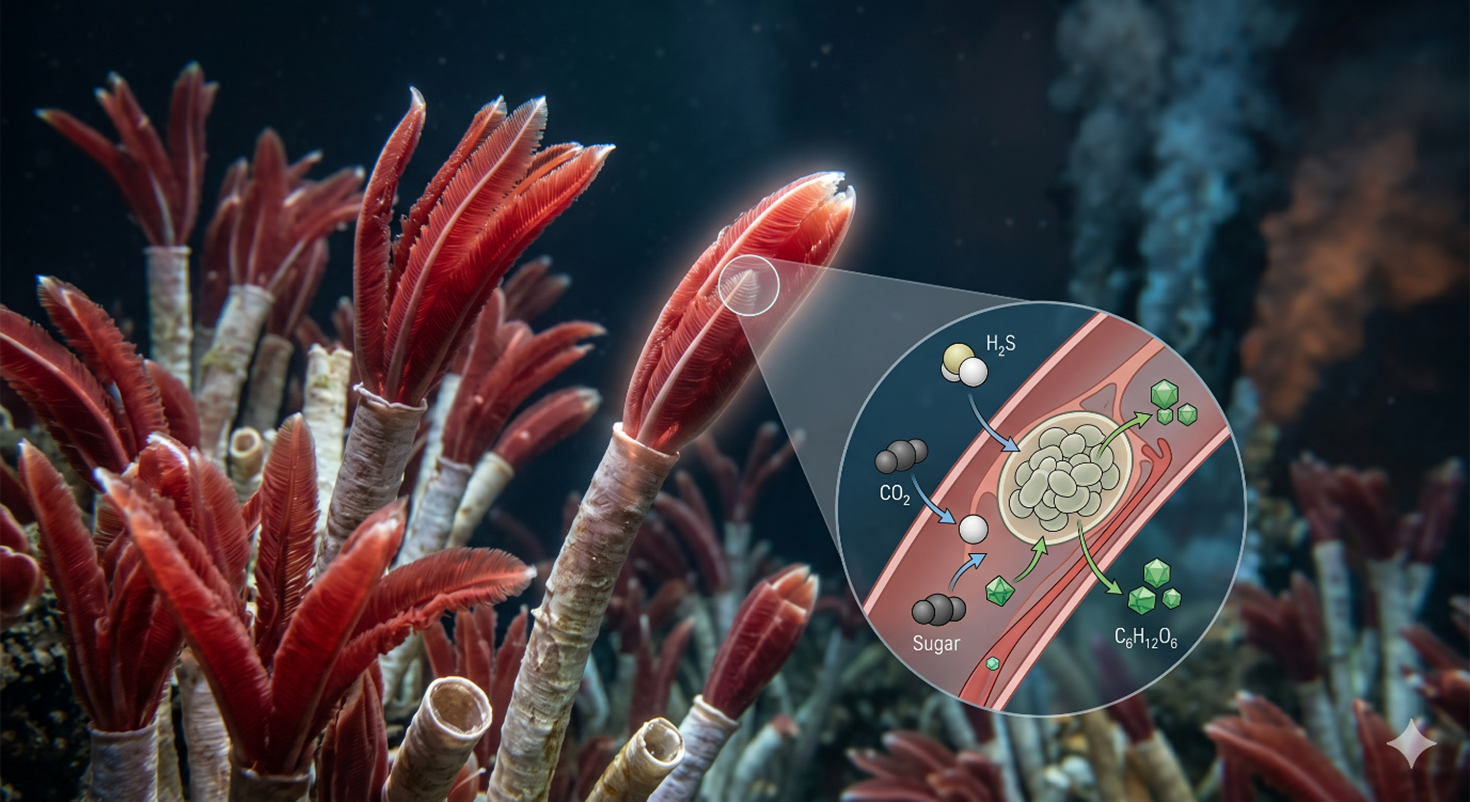
Tubeworm symbiosis Interaction. (Image was generated using AI)
Nearby, deep-sea mussels (Bathymodiolus) carry their own sulfur- and methane-eating bacteria tucked inside their gills, running two kitchens at once. At the Mid-Atlantic Ridge, shrimp (Rimicaris exoculata) farm dense layers of bacteria right on their bodies, while crabs and snails graze soft carpets of microbes like cows in an underwater pasture.
A vent field is always changing. Chimneys grow, collapse, and rebuild, breath by breath. With every puff of black “smoke,” the chemistry shifts and different microbes step forward. Heat-loving archaea dominate right next to the chimney; sulfur-eaters stitch together mats farther away; and at the cooler edges, methane-makers and methane-eaters trade gas and sugar. Scientists visit in tough little submarines to collect samples, measuring temperature, pH, gases, and metals to help match each microbe to its favourite chemical “recipe.”
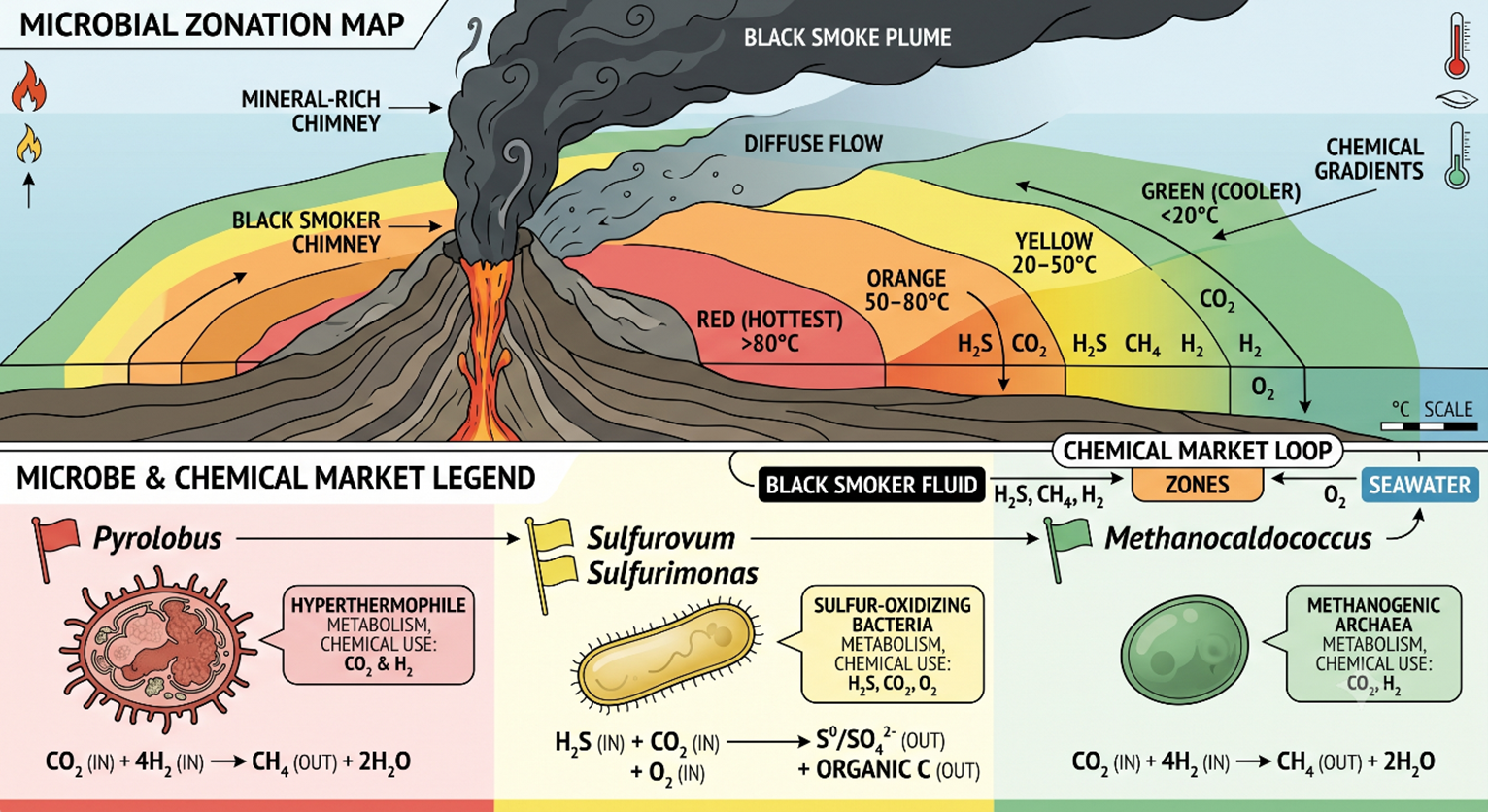
Microbial community zonation. (Image was generated using AI)
Why care about a city we can’t see from the beach?
First, vent microbes are ecosystem starters; without their chemical cooking, there would be no worms, crabs, or fish in this dark world.
Second, they are recyclers that turn toxic compounds into safer ingredients.
Third, they are teachers. If life thrives without sunlight on Earth, similar microbes might live in dark oceans beneath the ice of moons like Europa.
Finally, heat-tough enzymes from vent microbes already power lab tools and inspire greener industrial chemistry.
So picture the scene one last time: chimneys breathing like sleepy volcanoes, a tubeworm swaying while Endoriftia cooks lunch inside it, and a shrimp tending its personal garden.
Everywhere, trillions of microbes with real names and real jobs run a vibrant city without a single ray of sunshine. In the deepest darkness, the smallest citizens do the biggest work.
Prepared by:
Dr Mohd Faidz Mohamad Shahimin
Faculty of Chemical Engineering & Technology (FCET)
Water Research & Environmental Sustainability Growth (WAREG)
Universiti Malaysia Perlis (UniMAP)
Read more articles from the Fantastic Microbes series.
Note: The cover image was generated using AI. Additionally, AI assisted in moderating certain parts of this article to make them more appropriate for younger audiences.