After a heavy downpour, many Malaysians notice the same thing: the air feels fresher, the skyline becomes clearer, and the haze seems to lift.
It raises an obvious question. If rain can clean the air, why not use cloud seeding whenever haze or air pollution becomes severe?
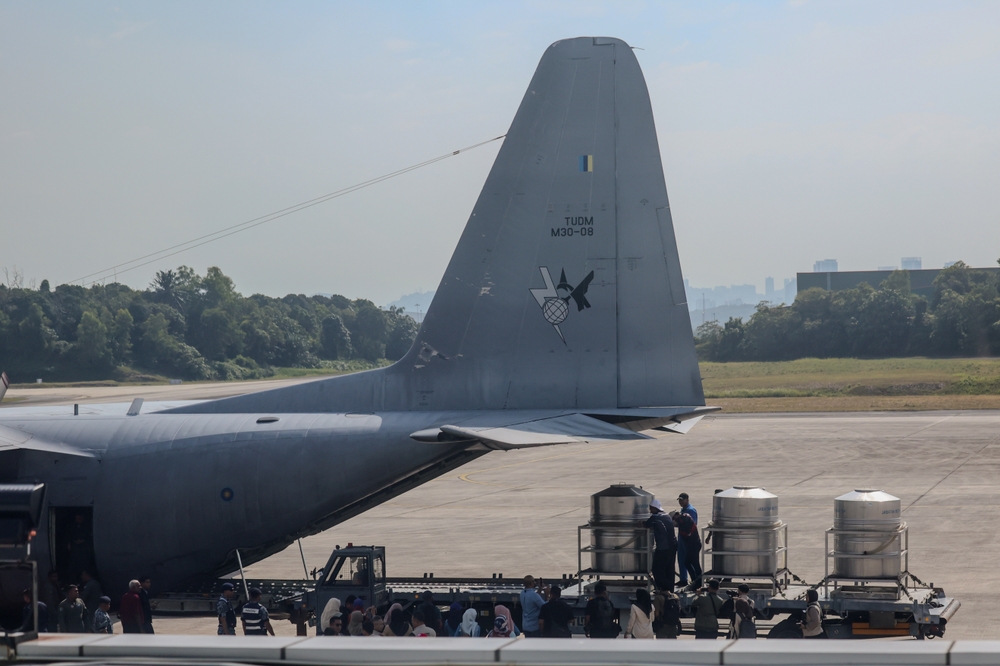
A Royal Malaysian Air Force aircraft being loaded with saltwater tanks for cloud-seeding operations. Shutterstock
Cloud seeding can be useful, but it is important to understand what it actually does.
It does not manufacture rain clouds from a clear blue sky. Instead, cloud seeding attempts to enhance rainfall from clouds that are already present and suitable.
In Malaysia, operations commonly involve dispersing a salt solution into suitable clouds to encourage water droplets to grow and eventually fall as rain.
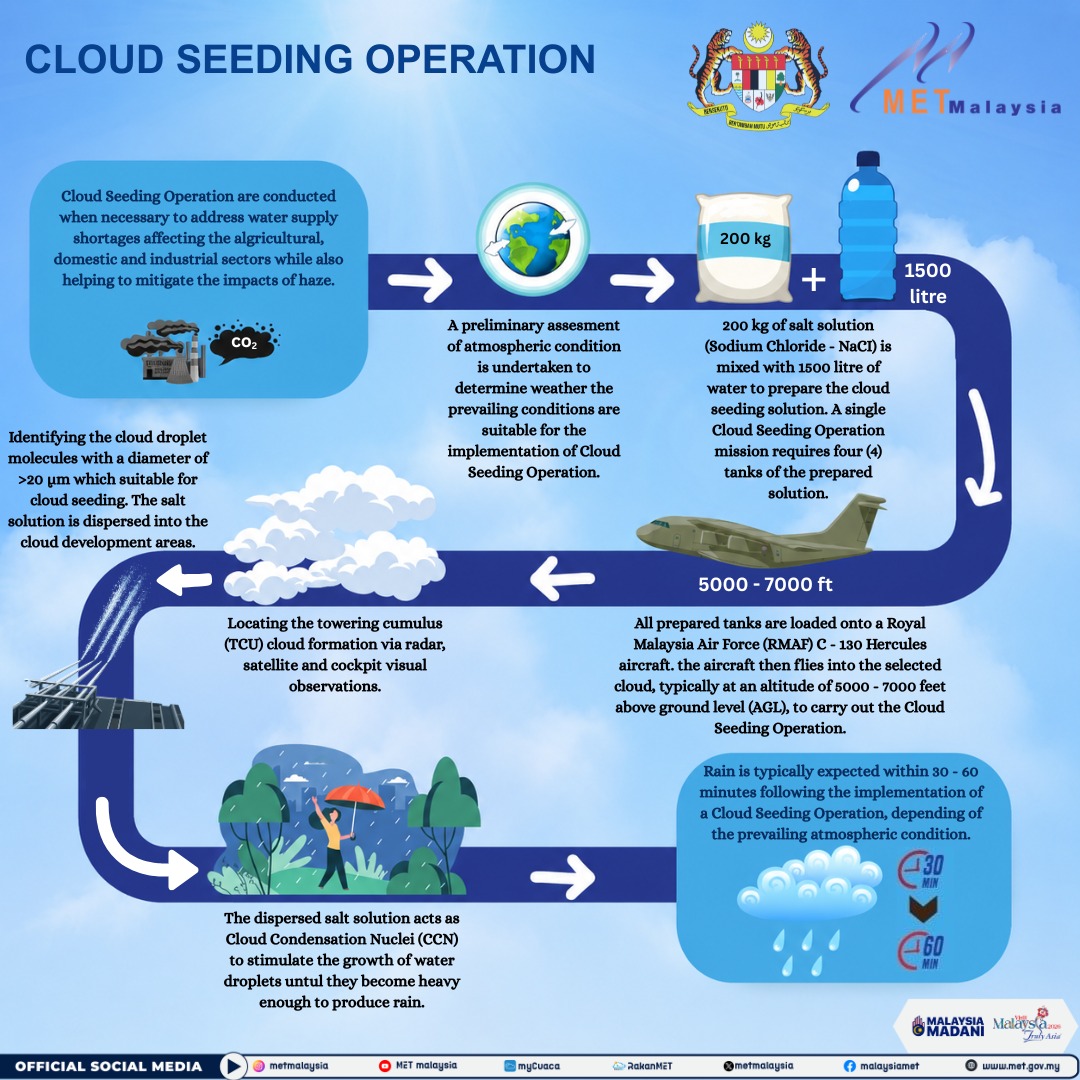
Cloud seeding operation process. METMalaysia
This means the technique is fundamentally dependent on the weather. There must first be sufficient moisture, suitable cloud development and favourable atmospheric conditions.
Even with cloud seeding, we cannot simply create large rain-bearing cloud systems or change regional wind patterns at will.
Rain can certainly help clean the atmosphere. As raindrops fall, they capture some airborne particles and carry them towards the ground through a process known as wet deposition, or more simply, “washout”. This is one reason particulate pollution such as PM2.5 and PM10 can decrease during and after sustained rainfall.
But there are limits.
A 2026 study of a cloud-seeding experiment in China’s Yangtze River Delta found local reductions in PM10 of about 25–29% and PM2.5 of 10–16% over three hours following seeded rainfall.
Yet when researchers considered a much larger area of about 9,000 square kilometres, the overall reduction in particulate matter was less than 1%.
The lesson is not that cloud seeding does not work. Instead, a local, temporary improvement in air quality is very different from solving a regional pollution problem.
Rain can wash some pollution out of the air, but it cannot turn off the pollution tap.
If fires keep burning, smoke can still arrive after the rain stops, carried by prevailing winds. Cloud seeding over Malaysia cannot extinguish fires hundreds of kilometres away, prevent new emissions from entering the atmosphere, or change the large-scale circulation that transports smoke across the region.
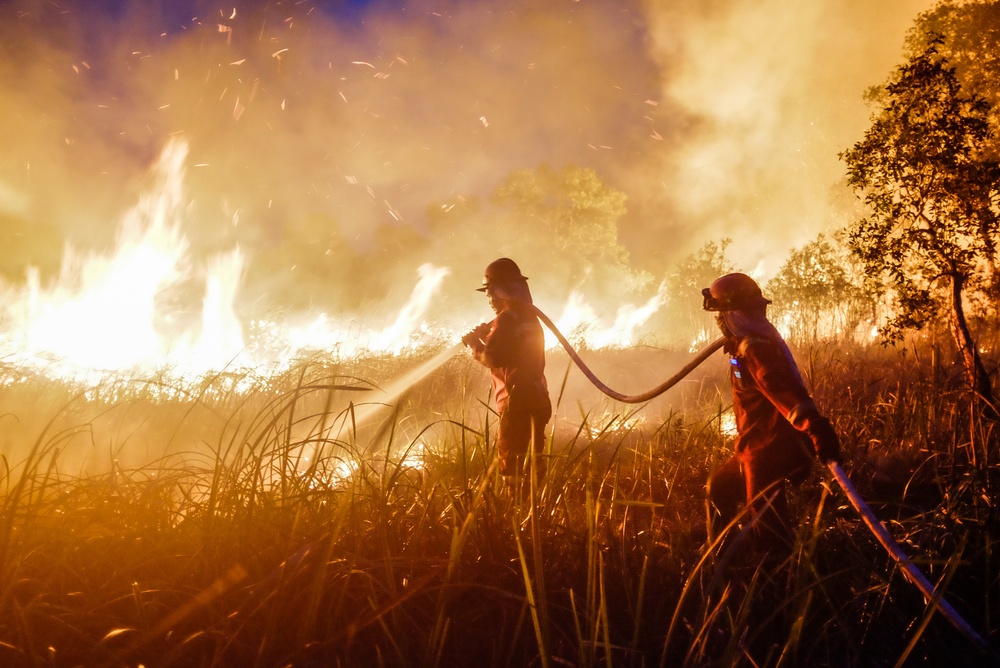
A Manggala Agni firefighter works to extinguish a land fire in Ogan Ilir Regency, South Sumatra, Indonesia on 15 August 2026. Shutterstock
The same limitation applies beyond haze episodes.
On ordinary days, road traffic, industry, construction, open burning and pollutants formed through chemical reactions in the atmosphere continue to influence the air we breathe. These everyday sources contribute to chronic exposure even when the skyline looks clear. Cloud seeding was never designed to address these sources.
There is also an economic dimension.
The Malaysian Government allocated RM5 million for cloud-seeding operations in 2026. More recently, it was reported that conventional cloud-seeding operations can cost upwards of RM100,000 per operation, depending on factors such as aircraft use, fuel, flight duration and logistics.
These figures do not mean that cloud seeding is a waste of public resources. During severe haze, prolonged dry spells or critically low reservoir levels, a well-timed operation may provide useful short-term relief when atmospheric conditions are favourable.
The important distinction is between an emergency measure and a long-term solution.
Sustainable air-quality management requires action closer to the source, such as preventing fires and open burning, reducing emissions from transport and industry, strengthening continuous air-quality monitoring, designing healthier cities and improving regional cooperation on transboundary pollution.
Cloud seeding therefore has a place in our environmental toolbox. Still, it should be the right tool for the right situation.
We may sometimes encourage rain. Cleaner air, however, depends on what we do before the clouds arrive.
Prepared by: