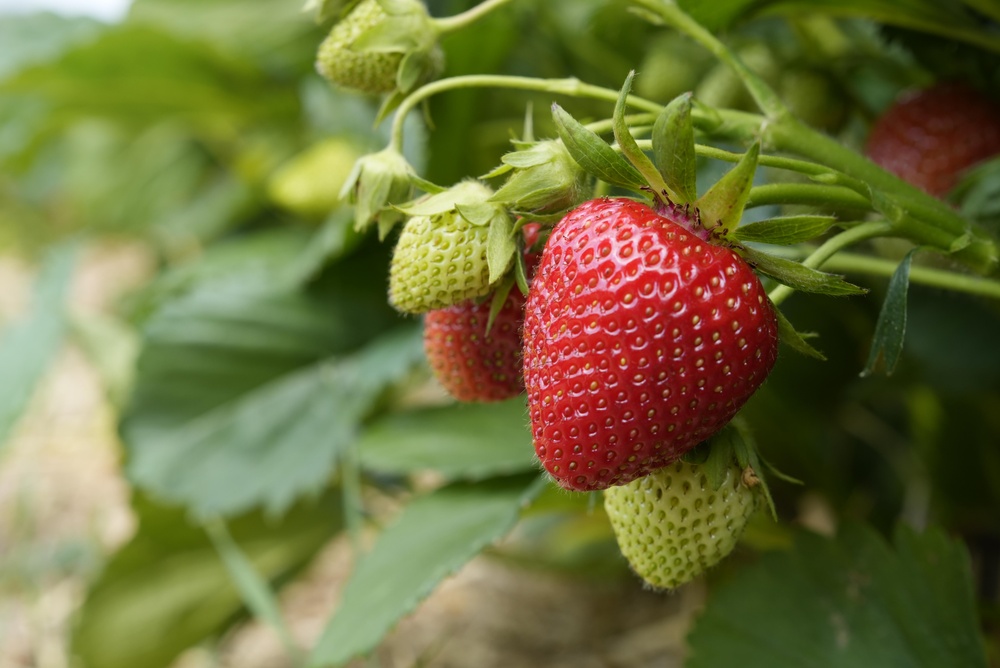
What if the strawberries you love hide something unseen? Beneath their red colour and sweetness, pesticide residues may remain. The concern is that these residues show no visible signs, and the fruit can look healthy while containing chemicals detectable only through analysis. Pesticides protect crops, but strawberries are especially vulnerable due to their delicate surface.
Instrument Spotlight
Basic Principle of Gas Chromatography-Mass Spectrometry (GC-MS)
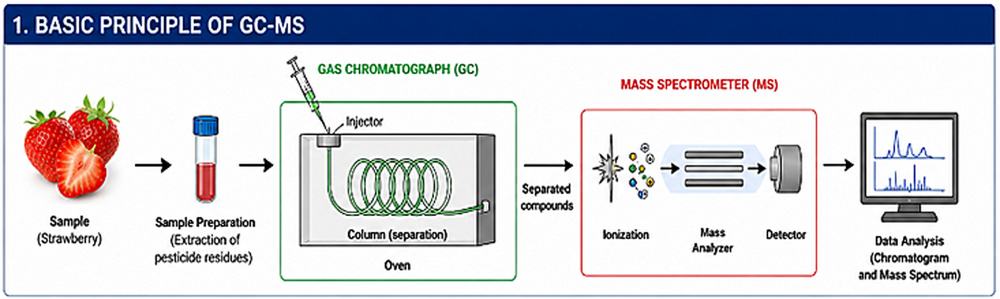
Conceptual schematic of the Gas Chromatography-Mass Spectrometry (GC-MS) analytical pipeline. Image created with AI.
The flowchart illustrates the steps from initial matrix sample preparation (strawberry pesticide extraction) through separation in a GC oven, ionisation and filtering in an MS module, and final data processing on a monitor interface.
Gas Chromatography-Mass Spectrometry (GC-MS) is a powerful analytical technique used to detect and identify trace pesticide residues in strawberries. It helps scientists accurately identify hidden chemicals.
In this analysis, the strawberry extract is injected into the GC-MS. The gas chromatograph separates pesticide compounds, while the mass spectrometer identifies them by mass and structure. GC-MS accurately detects pesticides and measures their concentration, ensuring food safety.
How does Gas Chromatography Separate Compounds?
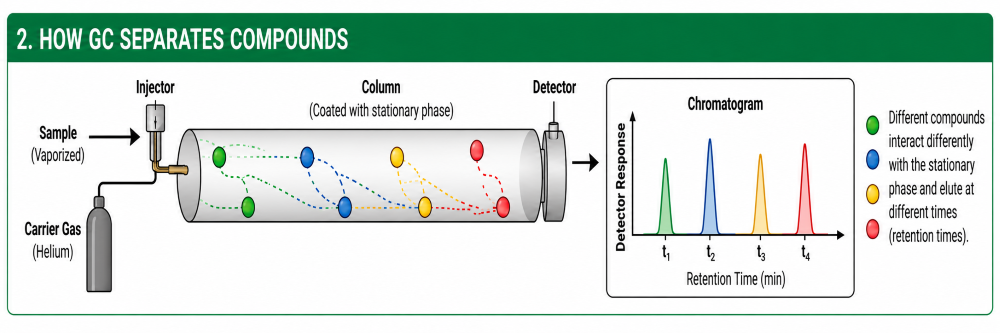
Schematic mechanism of compound separation via Gas Chromatography (GC). Image created with AI.
This diagram shows gas chromatography. A vaporised sample is injected and carried by helium gas into a column with a stationary phase. Compounds (green, blue, yellow, red spheres) interact differently and move at different speeds. They elute separately and form peaks (t1–t4) on the chromatogram, each showing a retention time.
After injection, the strawberry extract enters a heated chamber where it vaporises. Helium gas carries the vapour through a column coated with a stationary phase. Each pesticide interacts differently based on volatility, polarity, and molecular size, so it moves at different speeds and separates along the column.
As a result, each pesticide exits the column at a unique retention time, appearing as separate peaks on the chromatogram. This separation is essential because strawberries may contain multiple pesticide residues simultaneously, and GC must isolate them before identification.
How does Mass Spectrometry (MS) Identify Compounds?
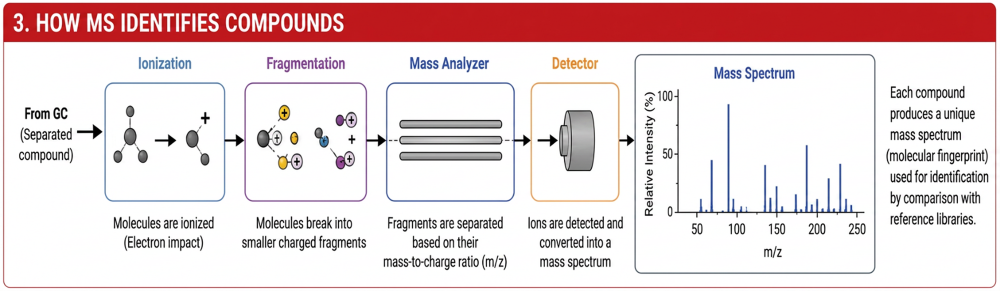
Conceptual overview of Mass Spectrometry (MS) compound identification steps. Image created with AI.
The workflow graphic shows a compound’s transformation through ionisation, fragmentation, mass analysis, and detection. The process ends with a mass spectrum chart showing ion intensity against mass-to-charge (m/z) ratios.
After separation, each pesticide enters the mass spectrometer (MS), where it is ionised into charged fragments. The analyser sorts ions by mass-to-charge ratio (m/z), and the detector produces a unique spectrum. Scientists compare this with reference libraries to identify pesticides, allowing GC-MS to detect residues in strawberries even at very low levels.
The Impact: Why GC-MS Matters for Malaysia?
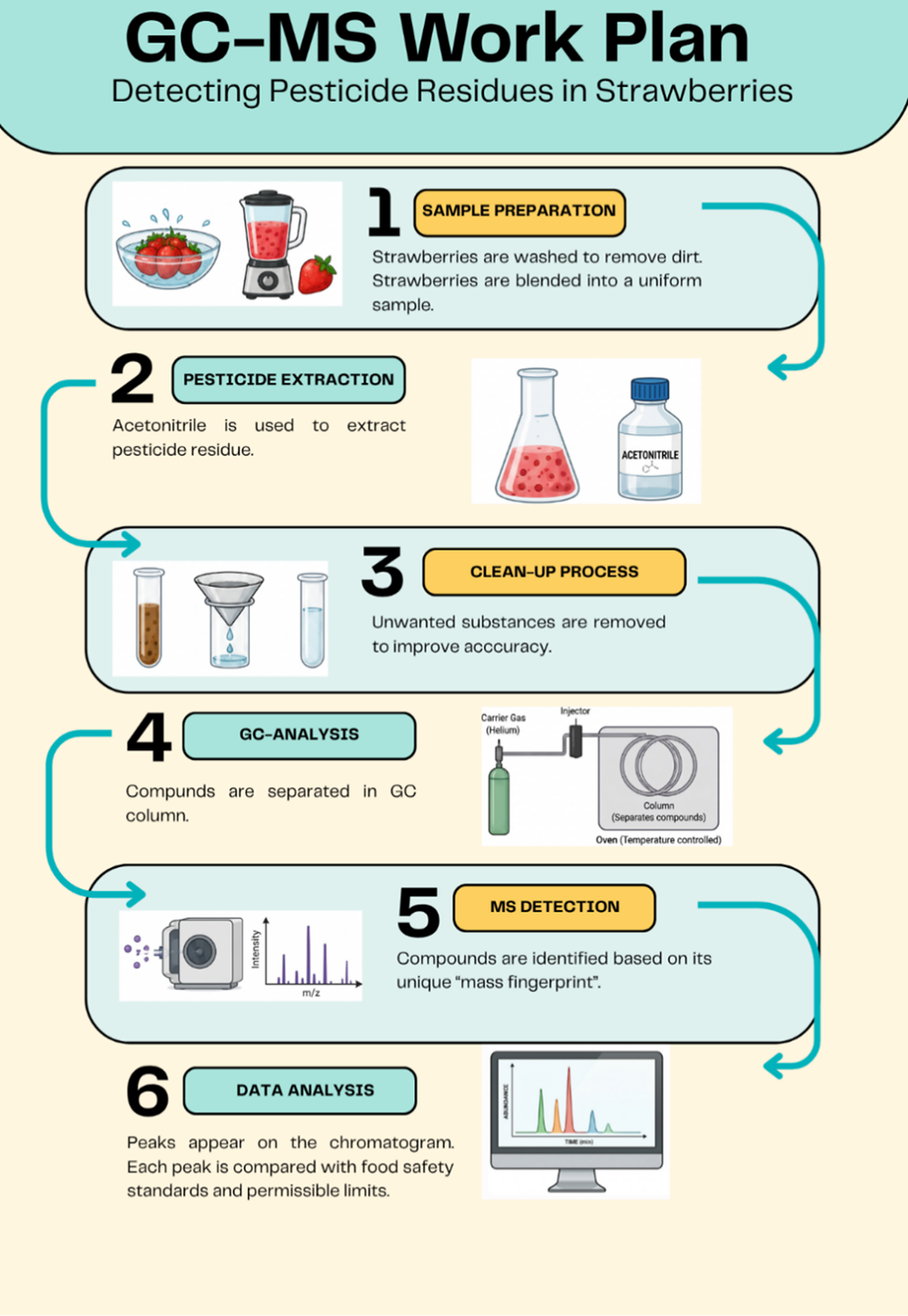
Workflow of Pesticide Residue Detection in Strawberries using GC-MS. Image created with AI.
The workflow chart shows a six-step plan for pesticide tracking, from homogenisation and acetonitrile extraction to instrument analysis, spectral recording, and food safety evaluation.
When pesticide residues exceed safe limits, they pose health risks such as cancer and reproductive issues. GC-MS enables rapid, accurate detection. In Malaysia, strict Maximum Residue Limits under the Food Regulations 1985 safeguard consumers and build trust. GC-MS also supports agriculture by ensuring local produce meets international standards and export requirements.
Conclusion
Pesticides protect crops, but residues on strawberries threaten health. Gas Chromatography-Mass Spectrometry (GC-MS) detects these hidden chemicals by separating compounds and identifying their molecular fingerprints. A six-step workflow ensures reliable food safety testing.
In Malaysia, GC-MS supports the Food Regulations 1985, protects consumers, and builds trust. It also strengthens agriculture by meeting export standards, keeping local fruits safe and competitive.
Prepared by:
Muhammad Nurfudhail Bin Mohd Fudjari, Nur Izzah Hana Binti Mohd Habsham, Nur Aqilla Hairina Binti Mohd Noor, Hana Dhamirah Binti Abdul Hanif, Siti Nur Atikah Binti Ab Hamid, Zulaikha Binti Zulhilmi, See Kah Jing, Muhamad Hakimi Bin Mahat, Muhammad Afnan Bin Ali, Nur ‘Ainun Adibah Binti Zaidi, Nur Syahidahtul Binti Md Nor San, Nur Zawani Izzati Binti Zakaria, Nurin Athirah Binti Mohd.Rizal
Universiti Tun Hussein Onn Malaysia
ACKNOWLEDGEMENTS:
The authors sincerely thank Dr Hana Syafiqah Binti Sayeed Ibrahim and Dr Mohamad Zulhafiz Shafiq Bin Zulhilmi Cheng from Universiti Tun Hussein Onn Malaysia for their invaluable guidance, academic advice, and support throughout this project.