The myth that scientists are bound solely to laboratories was debunked through science communication by Dr Felicita Fedelis during her interview with the e-estidotmy team. Felicita, an enthusiastic scientist hailing from Penang, recalls how being adventurous—trekking into the forest and setting insect traps with her friends—sparked her interest in Biology and shaped her into the scientist she is today. She is currently a Senior Lecturer in the Department of Physiology, Faculty of Medicine, Universiti Malaya.
e-estidotmy: When did you fall in love with science?
Felicita: I came from a lower-income family, but my parents really emphasised the love of knowledge. When my parents first bought me a set of encyclopedias, I was really fascinated by all the images and information, which sparked my curiosity about the finer details of creation. During my Sixth grade, my friends and I wanted to add some colour to our high school days and took unconventional approaches to explore Science topics beyond simply studying textbooks for exams. We volunteered for training with a botanist, Ms Lai Ee May, in Penang Botanical Garden and even went jungle trekking to find different types of plants and insects for our school project. I enjoyed nurturing my curiosity to understand how things functioned at the biological level. Perhaps this was one of the main reasons I ended up pursuing a Bachelor’s Degree in Biomedical Science at Universiti Malaya.
e-estidotmy: Who were some key figures in setting your career path?
Felicita: However, after completing my Degree, I was still figuring out what to do next and wanted my skills and talents to be utilised. I had some incredible university lecturers, such as Dr Noraishah Mydin Abdul Aziz, Assoc Prof Azlina Ahmad Annuar, and Prof Mary Anne Tan, who inspired me and recognised my knack for research. A life-changing moment was when I sat in person with the former Vice-Chancellor of Universiti Malaya, Datuk Dr Professor Ghauth Jasmon, one of the most revolutionary people I know. We spoke about my passion and interest in Malaria research. He suggested that I apply for a scholarship to pursue my PhD overseas to enhance my skills. After two years of the application process, with the support of the Physiology Department at UM, I secured a scholarship from the Ministry of Higher Education (MoHE) to pursue a PhD in Pathology at the University of Sydney, Australia, in 2011. Isn’t it worth the waiting process? Yes, look at the bright side; I had the opportunity to receive postgraduate training in Sydney.
e-estidotmy: What did you learn from your time in Sydney?
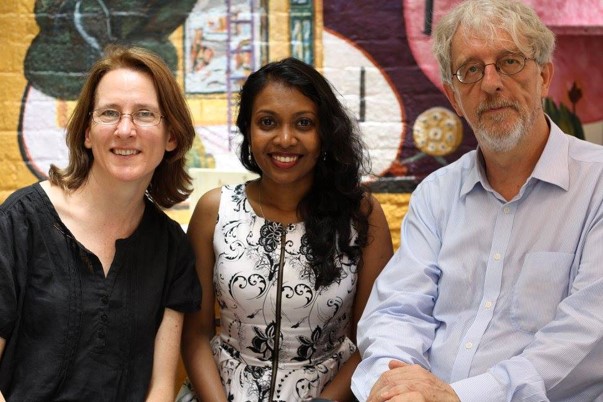
Dr Felicita Fedelis with her PhD supervisors, Prof Nicholas Hunt and Dr Helen Ball
Felicita: I was thrilled with my experience in Sydney, as I was exposed to a hot-pot of cultures and people. My entire perspective on research evolved under the mentorship of Prof Nicholas Hunt and Dr Helen Ball, experts in malaria and the kynurenine pathway. Although I was initially passionate mainly about malaria, I realised that research is a limitless field where the skills acquired can be applied in many ways across different research fields. From there, I started delving deeper into the Kynurenine pathway, which is a metabolic pathway that plays a critical role in generating cellular energy. I specifically started looking into how it modulates immune responses and why different individuals respond differently to diseases. When I returned after completing my PhD, I was interested in understanding the role of pathways in a more locally relevant disease such as Dengue.
e-estidotmy: When did you realise the need to communicate science?
Felicita: When the pandemic hit in 2020, I realised there was a huge need to communicate science to encourage understanding and inculcate an interest in science among the public. I realised that every scientist could engage more to communicate science than they do. I participated in the FameLab 2020 competition to lay the foundation for my career as a science communicator, and I was one of the finalists. FameLab gave me insight into the art of communicating science and how it can be utilised as a powerful tool to increase public science literacy. It was a life-changing experience which inspired me to make learning science infectious. It also provided me with the opportunity to collaborate with colleagues in Science Café KL, a webinar organised via social media platforms. It is an initiative to make science communication part of our culture and lifestyle, and to engage more with society’s needs.
Takeaway message
Felicita believes that educators are not simply knowledge providers but also have the responsibility to guide students in utilising knowledge with integrity and conscientiousness. She is passionate about instilling values in students that shape them into better people and, therefore, better healthcare personnel. Her deepest desire for all her students is that they will always enjoy learning and that the knowledge acquired will propel them forward. 🐝
Interviewed by Saarani Vengadesen