Discover how climate change can increase glacial flood risks and why disaster preparedness is vital for protecting communities and infrastructure.
On 26 August 2026, near Nepal’s border with China, a rock-and-ice avalanche unleashed a flood through the Lhende Khola, Bhote Koshi and Trishuli rivers. Water, mud and boulders devastated settlements, roads, bridges, border facilities and hydropower infrastructure. As of early October, more than 1,400 people had died, and over 5,000 remained missing; the figures were still provisional.
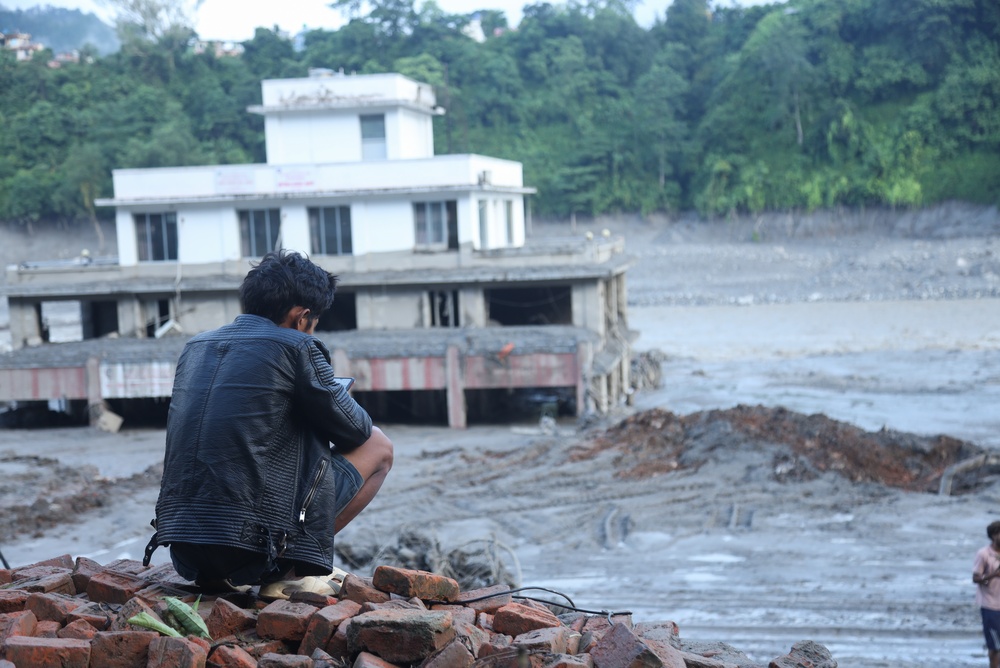
A massive flood in the Bhote Koshi River has affected riverbanks and nearby houses in Nuwakot, Nepal, causing widespread damage to homes, roads, bridges and other infrastructure in the area. Shutterstock
How can a glacier start a flood?
A glacier is a persistent mass of ice formed as accumulated snow compresses and recrystallises. Gravity makes it flow slowly downhill. Like a natural reservoir, it stores freshwater and releases meltwater that supports rivers and communities.
According to the International Centre for Integrated Mountain Development (ICIMOD), glaciers across the Hindu Kush Himalaya lost mass 65% faster in the 2010s than in the previous decade. Nepal’s estimated ice reserves shrank 29% from 1977 to 2010. Retreating ice can leave hollows where glacial lakes form or expand. Thinning glaciers can also reduce support for adjacent slopes.
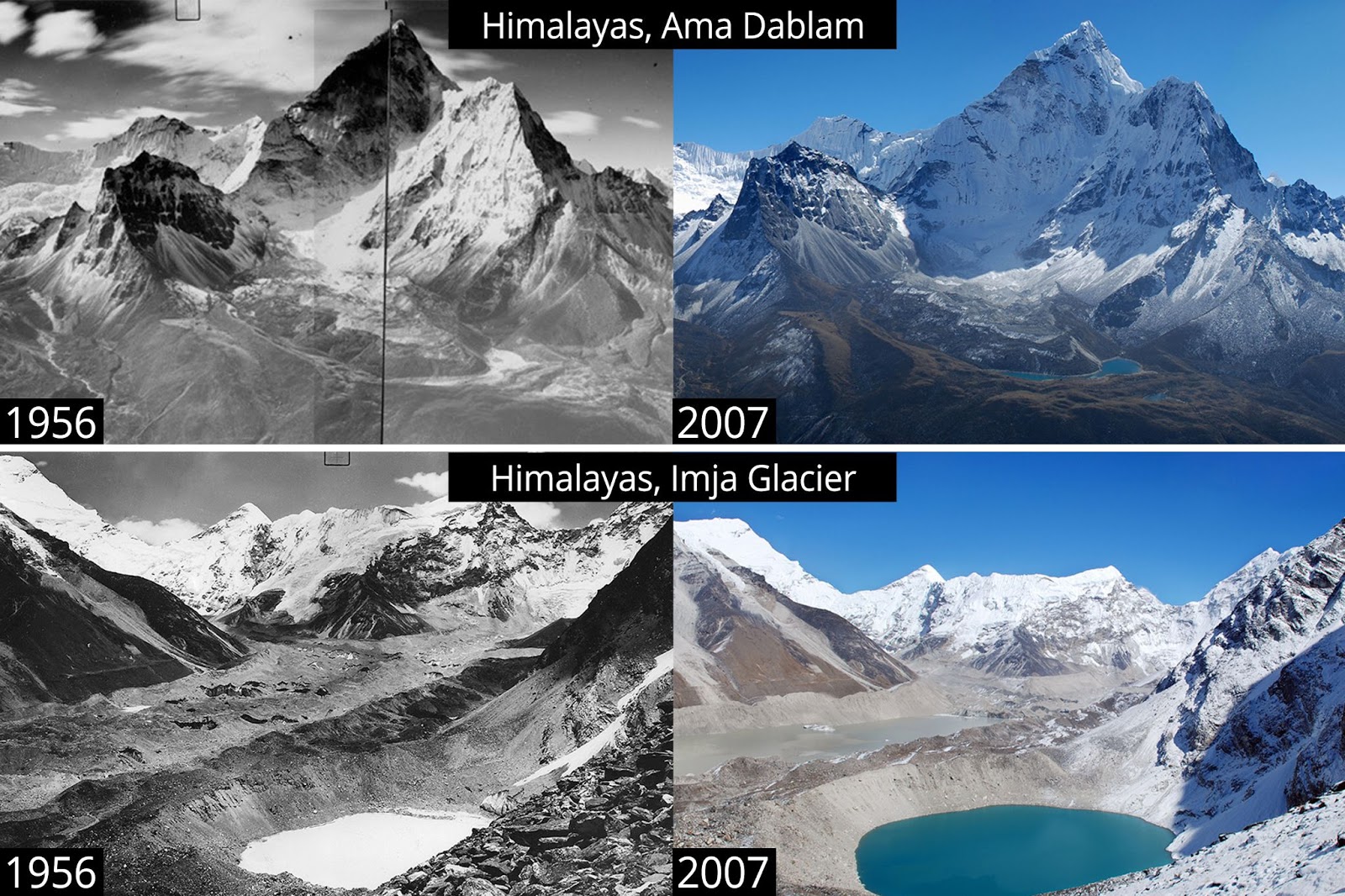
By comparing old photographs with his own more recent work, Alton Byers, an American researcher, mountaineer, and geographer, has documented glacial melt in the Himalayas. Photo credit: 1956 photos by Erwin Schneider, courtesy of the Association for Comparative Alpine Research, Munich, archives of Alton Byers. 2007 photos by Alton Byers, The Mountain Institute. NASA. Source
Climate change-driven warming affects rock too. Permafrost is ground that remains at or below 0°C for at least two consecutive years. Ice within its cracks can help bind rock together. Research shows that warming can weaken these bonds. Water entering fractures can also increase pressure, making an already unstable slope more likely to fail.
In Rasuwa, preliminary evidence suggests that a lower glacier section and adjoining rock failed at high altitude. The mass raced downslope into a river channel. A collapsing rock wall carried glacier ice into the river. Friction and impact can melt ice; the moving mass picks up water, sediment and boulders, becoming a debris-laden flood. Temporary river blockage remains under investigation.
The event should not automatically be called a glacial lake outburst flood, or GLOF. A GLOF involves the sudden release of water from a glacial lake held back by ice, a moraine or another natural barrier.
The Trishuli reportedly rose nine metres at Galchhi in 30 minutes, roughly the height of a three-storey building. Narrow valleys concentrate debris, threatening development downstream.
A similar disaster struck Chamoli, India, in 2021. Collapsing rock and ice unleashed a debris flow carrying boulders as wide as a six- to seven-storey building, severely damaging two hydropower projects.
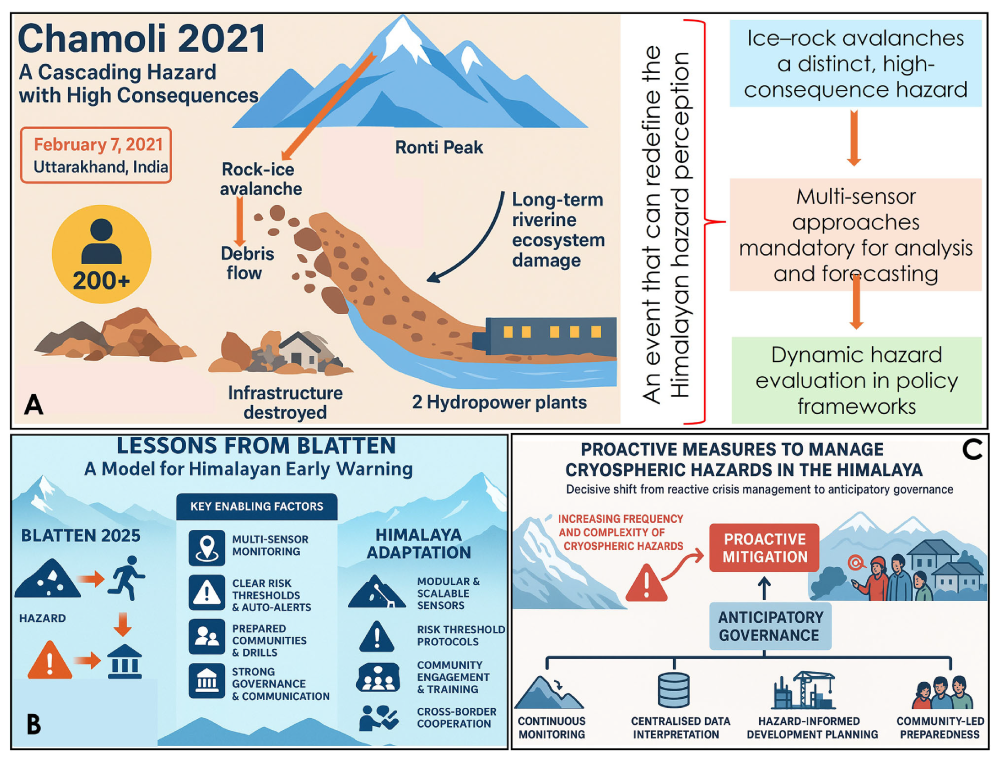
A. Chamoli illustrates how cascading ice–rock avalanche hazards exposed gaps in hazard perception, monitoring, and preparedness in the Himalaya.
B. Blatten shows how multi-sensor monitoring, clear thresholds, coordinated governance, and community preparedness enabled a successful evacuation despite extreme exposure.
C. Together, these cases inform a transferable framework for anticipatory governance based on continuous monitoring, centralised data interpretation, hazard-informed development planning, and community-led preparedness.
Here, climate change is best understood as a risk multiplier, not a single-cause explanation. Climate change can amplify risks, although its precise role in Nepal’s collapse remains under investigation.
Elsewhere, rainfall, freezing and thawing, or earthquakes can trigger failures. Hazards can interact, compound existing risks and trigger further events, creating cascading and compounding hazards.
This raises a common question: Are disasters more frequent or more visible?
Visibility and exposure have increased. Satellites, phones, and social media capture events that were previously undocumented. The World Meteorological Organisation recorded over 11,000 weather-, climate- and water-related disasters during 1970–2019. This does not prove that every “mega-disaster” follows a shorter timetable. Still, it warns that hazard, exposure and reporting are all growing.
Nepal’s flood reminds us that climate change is not simply warmer air. In high mountains, warming reshapes ice, rock, water, and the routes that connect them. Understanding these changes is essential for protecting people and infrastructure far beyond the glaciers themselves.
Nepal’s warning reaches beyond the snowline. In tropical landscapes, unstable slopes, rivers, and settlements are connected, too. However, scientific understanding must be matched by public preparedness. These events have different triggers, from intense rainfall to tectonic shaking.
Together, they illustrate how danger can travel beyond its source and continue after the first impact. For Malaysian communities, Nepal’s disaster offers a practical reminder: understand local hazards, heed warnings and practise evacuation.
Disaster-prevention and preparedness education is not optional or the responsibility of experts alone; it is crucial, life-saving knowledge for everyone, from children and households to communities, businesses, and governments. It is time to move from reacting to disasters towards anticipating risks and preparing before they strike.
People must recognise local hazards and warning signs, understand the basic do’s and don’ts, and know when and where to evacuate. By sharing knowledge, practising together, and strengthening cooperation, we can move forward collectively, build back better after disasters, and create safer, stronger, and more resilient communities.
Preparedness belongs in every household, school, workplace and community.
Prepared by:
Department of Water and Environmental Engineering
Faculty of Civil Engineering
with