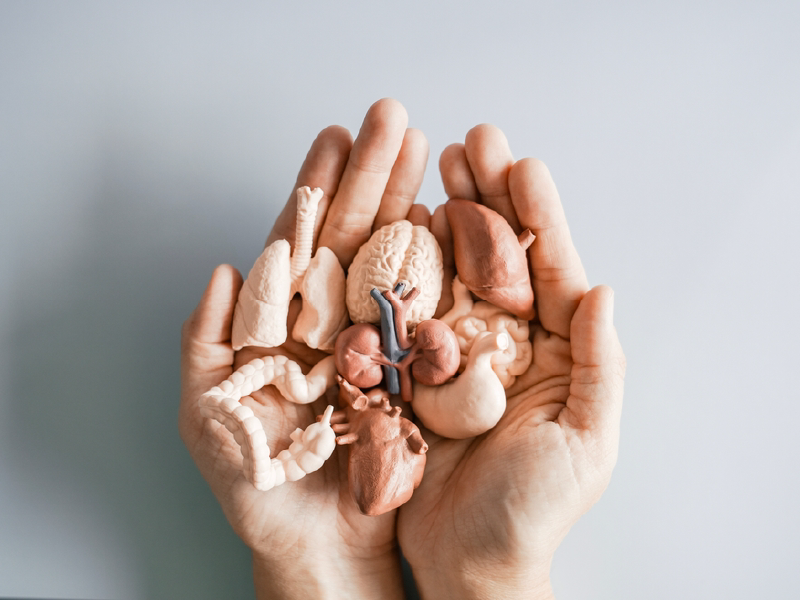
Imagine if you could take a single cell and, as a master architect with a self-building Lego set, watch it grow into a 3D “mini-version” of a human organ. This isn’t science fiction: it’s the world of organoids.
These 3D tissue structures are designed to mimic the complex architecture and functionality of our actual organs, such as the brain, liver or kidneys.
A Century-Long Journey
The story of organoids actually started in 1907 with an experiment on sponges. Scientist Henry Van Peters Wilson discovered that if you broke a silicate sponge apart into individual cells, they could actually reconstruct themselves into functional creatures.
Think of this like taking a puzzle apart, throwing the pieces in a box, and having them click back together on their own!
Over time, this led to the discovery of stem cells—first in mice in 1981 and then in humans in 1998.
A major “eureka” moment happened in 2009 when researchers grew the first 3D intestinal organoid from a single adult cell, proving that we could create complex systems like the stomach or lungs in a lab.
How to “Grow” an Organ?
Making an organoid is like nature’s version of 3D printing. Scientists start with stem cells, which act as “blank slates” that can turn into any cell type. These cells are placed in a special environment that mimics the human body.
To help them grow, scientists use:
- A scaffold: Usually a biological gel (like Matrigel) that acts like a construction frame or a “cradle” to support the 3D shape.
- Chemical cues: Growth factors that act like GPS directions, telling the cells exactly what kind of tissue to become.
One of the most amazing parts is self-organisation. Given the right conditions, the cells “know” how to arrange themselves into functional tissue.
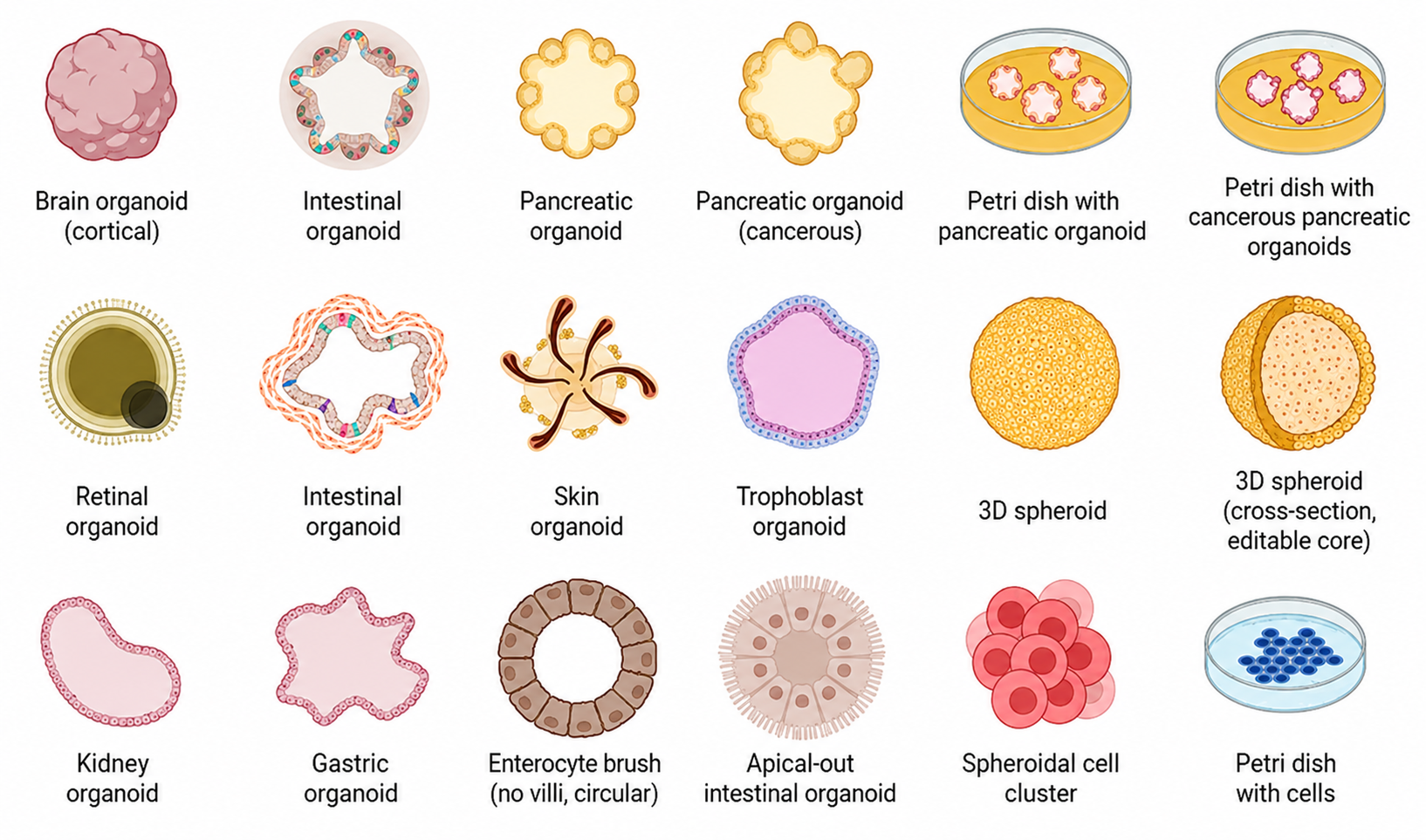
An image of the various types of organoids available (Created using BioRender)
Why Do We Need Them?
Organoids are changing the way we fight diseases and develop medicine:
- The “flight simulator” for diseases: Instead of testing dangerous viruses like SARS-CoV-2 on humans, scientists can use organoids as a safe testing ground to see how infections spread.
- Personalised medicine: Scientists can grow “Patient-Derived Organoids” (PDOs) using a person’s own cells. This is like having a “mini-me” of your own organs to test which specific cancer drug will work best for you before you ever take a dose.
- Ending animal testing: Organoids provide a more realistic human response than animal models, helping pharmaceutical companies test if a drug is toxic without relying on animals.
- Spare parts for the body: In the future, organoids might act as biologically grown “spare parts” to repair damaged heart tissue after a heart attack or replace a failing liver.
The Road Ahead: Challenges and Ethics
While the future looks bright, there are still hurdles to clear. Currently, organoids are not yet perfect; they often lack the full maturity of real human organs. Bioengineering tools are still catching up to the complexity of the human body.
There are also deep ethical questions to consider. For example:
- Privacy: Since organoids contain a person’s genetic “blueprint,” how do we protect that data?
- Consciousness: As brain organoids become more complex, scientists must monitor whether these “mini-brains” could ever develop any form of awareness.
In a nutshell, think of Lego, link to organoids!
Prepared by:
Dr Lee Tze Yan
Dr Lee Tze Yan is currently a senior lecturer and the programme coordinator for the biomedical science programme at Universiti Kuala Lumpur, Institute of Medical Science Technology, under the Clinical & Biomedical Laboratory Science Section.