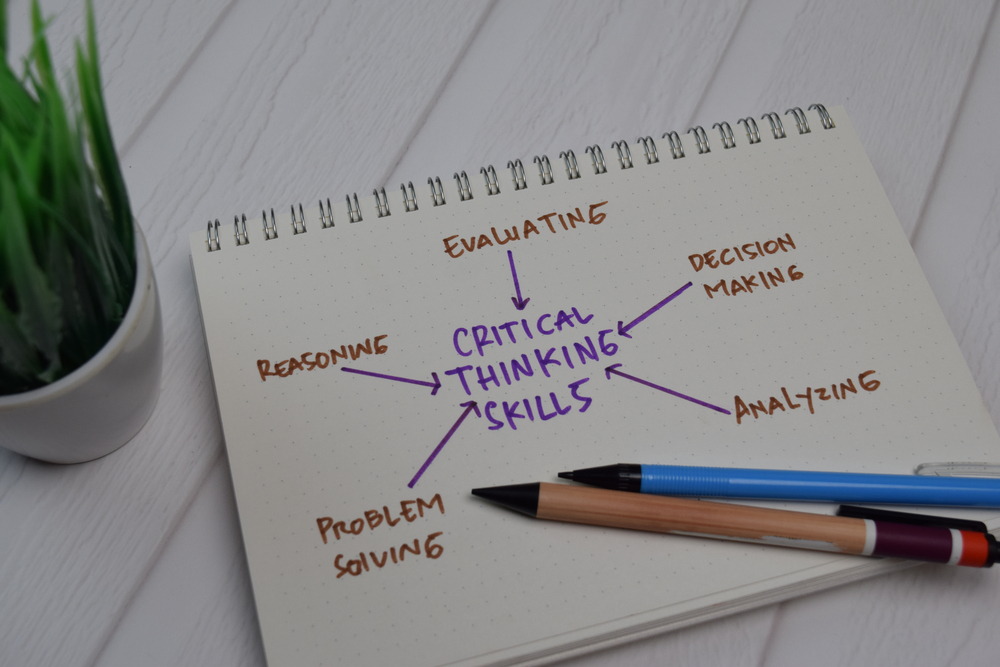
Critical thinking is the ability to analyse and evaluate the truthfulness of information before accepting it as fact.
In today’s world, we receive information from a wide range of sources, but not all of it is accurate or reliable. There have been many cases of people falling victim to scams because they accepted information without questioning its validity.
Therefore, it is important to think critically about the information we encounter. This involves applying logical reasoning, considering different perspectives, and drawing informed conclusions based on the evidence available and one’s own stance on the issue.
Let’s look at one example:
A café’s review has 4.7 stars by 410 people. From the surface, this information appears good. By applying critical thinking, this means that we analyse this information by asking:
“Who are these 410 reviewers?”
“Were the reviewers rewarded with free dessert after giving good reviews?”
“When were the reviews given?”
And most importantly,
“What are your own preferences when deciding on a café?”
“Would my family or friends like to go to the location of the café that has limited parking space?”
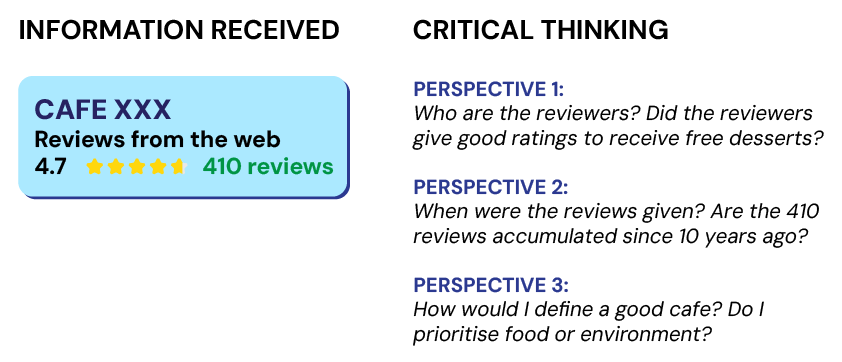
We try to engage at least three different perspectives on the information we receive.
Perspective no. 1 is the source. Ask yourself:
“Is the source of that information reliable and valid?”
“Who wrote that article?”
“What expertise does that person have?”
Next, perspective no. 2 is the timing.
“Was that information written quite some time ago?”
“Was that information written as a response to a certain situation?”
Following that, perspective no. 3 is your own preference, which involves deeper reflection alongside the perspectives of family and friends.
Instead of flowing along with the crowd, what are your own needs?
Let’s look at another example.
To avoid food waste and make life easier (i.e., save time and money), many people cook more food for dinner.
After dinner, they keep the leftovers in the fridge and reheat them the next day for breakfast or lunch.
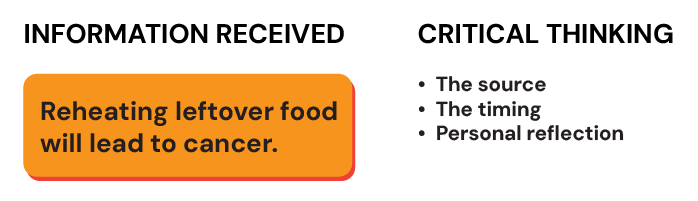
However, some people oppose this practice with the warning that reheating leftover food will lead to cancer.
How can we engage with this situation with critical thinking?
The Scripture mentions that “The first speech in a court case is always convincing — until the cross-examination starts!” (Proverbs 18:17).
It is always good to cross-check the source and then consult other reliable, valid sources on the same topic.
According to Medical News Today, rice and other hot foods left at room temperature for more than 2 hours are more likely to develop bacteria.
Perspective no. 1: Is this medical website a reliable and valid source (i.e., being reviewed by experts in the medical field)
Perspective no. 2: Is the website updated to the current year? Also, did another health website on nutrition mention similar content?
Perspective no. 3: How do you and your family feel about consuming dinner within two hours, and then keeping the leftovers in the fridge to reheat them for meals on the next day?
By applying critical thinking in our daily lives, especially when evaluating information from different channels (e.g., websites, social media), we are practising skills that help us become better consumers.
This behaviour will lead to better well-being (e.g., a healthy body). We avoid blindly following the crowd out of fear or excitement (e.g., fearing cancer after eating leftover food, or getting excited about a highly reviewed café, only to be disappointed afterwards).
Let’s always cross-check the information around us with tact and diligence!
Prepared by:
Dr Ng Joo Hou (Joshua)
Department of Psychology and Counselling
School of Psychology and Social Sciences
IMU
Dr Ng Joo Hou (Joshua) completed his PhD in Psychology (University of Exeter, UK), focusing on academic learning environments, social identity and holistic well-being. He is passionate about human flourishing through education and counselling in the Malaysian context.