
Imagine a forgotten player, suddenly being called up to the big leagues to replace the superstar. Muons were discovered way back in 1937 by C. Anderson and S. Neddermeyer.
This subatomic particle, often described as a heavier cousin of the electron, existed somewhat in the shadows.
But hold on tight, because the muon is about to take the centre stage to help scientists unravel some of the universe’s most mind-blowing mysteries.
So, What Exactly is a Muon?
Now, picture something like an electron, but with a bit more SUPERPOWER. Muon isn’t made of anything smaller – it’s one of the most basic ingredients of reality.
Muons are significantly more massive, about 207 times heavier than electrons. But here’s the kicker: they’re incredibly unstable, they decay, or break down into lighter particles, in a ridiculously short amount of time – just 2.2 microseconds!
That’s like the blink of an eye, only way, way faster and can only be detected by technology.
In that brief moment, muons interact with other particles through fundamental forces. These interactions make them so valuable to scientists.
Muon Factories: Turning Up the Intensity!
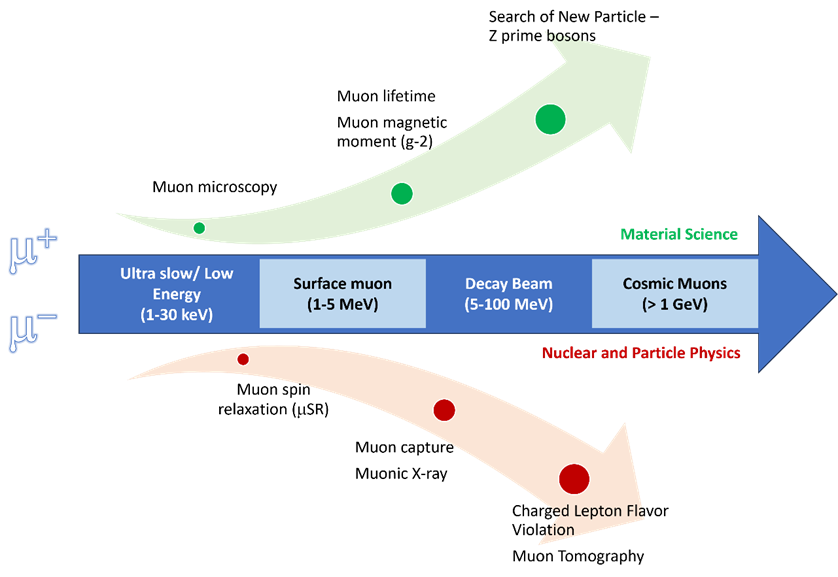
Scientists are now building dedicated “muon factories”. These facilities are equipped to generate extremely concentrated, focused beams of muons.
By directing, manipulating and meticulously studying these intense muon beams, scientists gain unprecedented opportunities to observe rare, elusive particle reactions.
These observations are like puzzle pieces, potentially piecing together insights into entirely new particles, forces, and phenomena yet to be seen by modern physics.
These facilities are real, tangible places around the world. Prominent labs in Japan (Research Center Nuclear Physics (RCNP), Osaka and Japan Particle Accelerator Research Complex (J-PARC), Tokai), Switzerland (Paul Scherrer Institute (PSI), Villigen) and the United Kingdom (ISIS Neutron and Muon Source, London) are all spearheading this effort. International collaborations and the sharing of expertise are vital to pushing the boundaries of muon-based investigations.
Muons: Probing the Unknown
Muons act as incredibly sensitive detectors of the universe’s subtle secrets. Scientists are studying their “anomalous magnetic moment,” or “wobble,” which deviates slightly from predictions based on current physics.
This wobble could hint at undiscovered particles or forces! They’re also looking at extremely rare decays in which the total amount of matter is ever so slightly different, which challenges current understanding and might indicate new physical regions.
Beyond fundamental research, muons’ ability to penetrate materials opens doors to practical applications.
For example, by exploring both internal and underground environments with their advanced technology, muons have practical applications in material analysis.
These insights can fuel advancements in various technological fields. By advancing technology and these benefits, we will see the light of an efficient and sustainable society.
This means we can gain more knowledge of what Earth stores, helping humans discover and innovate.
Malaysia: Charting its Course in the Muon Science Arena
For 15 years, Malaysia has actively pursued becoming an important contributor to global muon science. Malaysian institutions and scientists aren’t just watching from the sidelines but working to contribute.
A key figure is Dr Izyan Hazwani Hashim from Universiti Teknologi Malaysia (UTM), whose expertise in muon physics is driving this effort.
Dr Izyan’s contributions are important. She started as a postgraduate researcher at RCNP, Osaka. She developed an international partnership for the MONUMENT experiment, which 33 individuals from 13 institutions currently support.
This effort puts Malaysia at the cutting edge of research on these tiny particles and helps us understand the universe.
Dr Izyan’s work, alongside planned investments, emphasises the amazing potential for Malaysia to contribute to the global muon science community.
Malaysia can also help with global partnerships, build local skills, and contribute to important discoveries about the universe, such as new theories, detectors, and data.
Through planned investments and international partnerships, Malaysia could position itself in the global muon science community.
The Future is Muon-tastic!
With brighter muon sources on the horizon, the future is wide open! Muons will help us test fundamental physics, develop innovative materials, and revolutionise our understanding of the universe.
Keep an eye on these tiny particles – they’re just getting started. They are sure to reveal incredible secrets of the universe!
Prepared by:
Dr Izyan Hazwani Hashim
Universiti Teknologi Malaysia